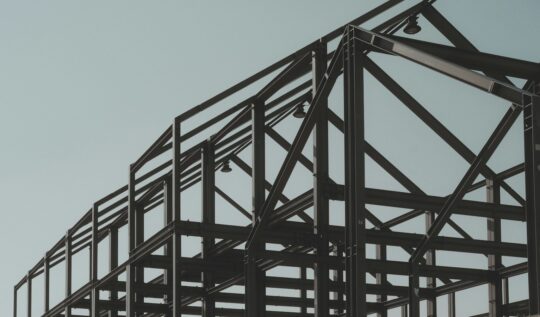
“Photographs, which cannot themselves explain anything, are inexhaustible invitations to deduction, speculation, and fantasy.”
Susan Sontag, essayist and author of On Photography
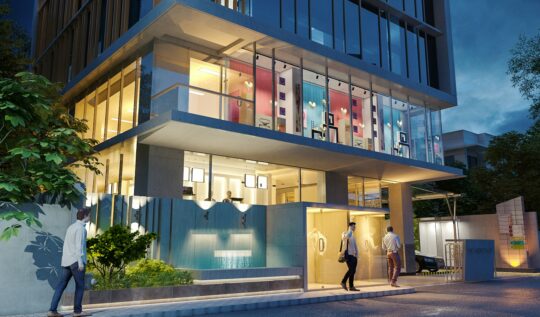
The pastor slid a phone across the table before we had finished introductions. On the screen was a worship center at dusk: a two-story glass lobby glowing from inside, a roof that seemed to float on nothing, a plaza full of families, and a parking lot nowhere in sight. It was an AI architectural rendering he had made the night before, typing a few sentences about what the church had been praying toward for years, and he wanted to know how close to it we could get. It is a scene we expect to see more often, and it deserves a better answer than either “that’s wonderful” or “that’s not real.” An AI image of this kind is a genuinely useful thing to bring to a first meeting. It is also a picture of a building that does not exist and, in most cases, could not exist on that site, at that budget, under that building code, and the difference between those two statements is what every owner needs to understand before the image goes anywhere near a capital campaign.
Why the first picture now comes from AI
This is not a fringe habit. In a survey of 442 U.S. Protestant pastors that Barna Group fielded in December 2025 and published in June 2026, only 13 percent said they do not use AI at all, and 37 percent said they use it for graphic design or visual creation. Barna’s own reading is that smaller churches without a communications budget are using these tools to fill a gap that would otherwise go unfilled, which matches what we see. The same tools are in the hands of the hotel owner sketching a lobby renovation, the franchise operator imagining a new storefront, and the building committee member who wants to show everyone else what “warm and modern” means. Typing a description and getting back something that looks like a professional photograph takes about a minute, and nobody should be surprised that people do it.
Architects are moving more slowly. The American Institute of Architects reported in March 2025 that only 6 percent of architects regularly use AI in their work, though architects under 35 were significantly more likely than their older colleagues to have used image generators. In the same research, 90 percent of architectural professionals said they were concerned about problems including the accuracy of what AI produces. That gap matters more than it might seem. It means the first image of many new buildings is now being made by the owner, before an architect is involved, by a tool that knows a great deal about what buildings look like and nothing about how they work.
What an AI image is actually good for
We would much rather see that picture than not see it. Most owners struggle to describe the building they want, and they are not to blame for that; architectural vocabulary is specialized, and “I want it to feel open but not cold” is a hard sentence to design from. An image, even an impossible one, shows us what someone is reaching for. When a pastor shows us a glass lobby glowing at dusk, he is usually telling us several real things at once: that he wants the building to look welcoming from the road at night, that the current foyer feels cramped and dark, and that he wants people to see activity inside before they decide to walk in. Those are design goals we can work with, and the image surfaced them faster than an hour of conversation might have.
AI images are also useful for disagreement. If three committee members each generate their version of the new sanctuary, the differences between the pictures reveal differences in expectation that would otherwise stay hidden until schematic design, when they are more expensive to resolve. One person’s image has a balcony, another’s has a low and intimate room, a third has a stage that could host a concert. That is a conversation the committee needs to have, and having it with free pictures in the first month is far better than having it over revised drawings in the sixth. Used this way, AI imagery is a kind of mood board that talks back, and we treat it as legitimate input to the building program.
What it cannot promise
The trouble starts when an image is mistaken for a design. An image generator working from a text prompt does not know where the site is, which way it faces, what the soil can carry, what the local zoning allows, or how many people the room has to hold. It does not know that a two-story west-facing glass wall in southwest Missouri will turn a lobby into a greenhouse on a summer evening unless it is shaded, or that the roof floating on nothing needs columns, beams, and a structural depth that will change its silhouette considerably. It has no idea that a sanctuary of the size shown would need a particular number of exits, restrooms, and parking spaces, or that the plaza full of families sits exactly where the stormwater detention would have to go. None of this is a flaw in the tool. It was never asked to solve those problems and it does not pretend to.
Stephen Springs, an architect writing in Athletic Business in May 2026, describes the same problem from the profession’s side. In his experience, only a handful of every few hundred AI-generated design ideas were usable, and the rest showed the building equivalent of a hand with the wrong number of fingers: steps that lead nowhere, structures that defy gravity, materials used in ways that make no sense. He also noticed something subtler. Even when his firm used AI to dress up its own renderings of a recreation center restroom, the tool filled in fixtures and finishes that looked spectacular but that the firm would never specify, including a faucet that did not exist anywhere, and the municipal client looked at the result and said it looked like a hotel. The image had quietly raised the expectation beyond the project.
There is also a quieter limitation that most owners do not notice until they try to use the image for something. An AI picture is a single view, not a model. Ask the same tool for the same building from the parking lot, or for the inside of the lobby you just saw from outside, and it will give you a different building that happens to share a mood. The window count changes, the roof changes, the entry moves. A professional rendering is a camera placed inside a three-dimensional model that also produces the floor plans and the construction drawings, so every view is the same building and every view can be traced back to something that will actually be built. An AI image is a picture of a building that has never had to stand up.
An AI image is a picture of a building that has never had to stand up.
The campaign problem
All of this is harmless while the image stays in the planning conversation. The risk arrives when it goes on the cover of the campaign brochure. A photorealistic picture reads as a promise in a way a sketch never does, because people have spent their whole lives learning that photographs show things that exist. A congregation that gives toward a glass lobby and a floating roof believes it is giving toward that building, and when the real design arrives with columns, shading, a smaller footprint, and a parking lot in plain view, the gap can feel like a broken commitment even though no one intended to mislead anyone.
From the research
“It’s no longer simply a representation of an idea. Rather, it’s become an extremely literal, photographically realistic image that creates a client expectation that if somehow we, as architects, don’t deliver exactly what’s depicted, we’ve lied about our intentions.”
Athletic Business, Stephen Springs, “The State of AI in Architecture (for Now)”
We have written before about what even a professional rendering leaves out, and every concern in that piece applies more strongly here. A professional campaign rendering made in schematic design is at least built on a real floor plan, a real site, and an early cost estimate, so the distance between the picture and the finished building is measurable and can be explained. An AI image has no plan underneath it at all, so the distance is unknown. The cost of that unknown is not paid on bid day. It is paid two years later, when a donor walks into the finished lobby, remembers the picture, and quietly concludes that the leadership oversold the project, which is exactly the person a church will need to ask again for the next phase.
There are fair counterarguments, and we take them seriously. Some churches will say that every campaign image is aspirational and that people understand this, and for an early vision night that is arguably true. Others will point out that a small congregation cannot afford professional renderings before it knows whether a campaign is viable, so an AI image is the only picture they can show. In both cases the answer is not to ban the image but to label it honestly. “An early idea of the feeling we are praying toward, not the final design” printed beneath the picture costs nothing and protects everyone. What we would advise against is putting an unlabeled AI image in front of donors once a real design exists, or using one to describe specific features such as seat counts, square footage, or a particular material that nobody has confirmed can be built for the money.
Worth knowing
Before any image reaches a donor, ask one question: can someone show us the floor plan behind this picture? If the answer is yes, it is a rendering of a design. If the answer is no, it is inspiration, and it should be labeled that way.
How to bring an AI rendering to your architect
The most useful thing an owner can do with an AI image is bring it to the first meeting along with the words behind it. Save the prompt you typed, because it is often more revealing than the picture. Mark what you love about the image and what you were indifferent to; “the light in the lobby” and “the roof shape” are very different instructions, and an architect cannot tell which one mattered most from the image alone. If several people on your committee made images, bring all of them and expect to talk about the differences rather than voting on a favorite. And be ready to hear that some of what you love will cost more than the rest of the building can afford, because that conversation is far cheaper now than after the design is drawn.
From there, a good architect does the work the image skipped. The goals inside the picture become part of the building program, the site analysis tells us where the building can sit and which way the glass can face, the code analysis tells us what the room has to provide, and the first massing studies show what the building wants to be once all of that is real. Only then does visualization begin in earnest, and it begins from a model rather than a prompt, so the lobby view, the street view, and the sanctuary interior all show the same building. AI tools have a legitimate place in that later stage too, for adding people, planting, and atmosphere to a rendering built on a real model, provided someone is checking that the tool has not quietly added a faucet or a skylight that is not in the drawings. That is the kind of architectural visualization a campaign can safely stand on.
The right outcome for the pastor with the phone is not the building in his picture. It is a building with a lobby that still glows at dusk, perhaps facing east rather than west, with columns you can see if you look for them, and smaller than the one he imagined, which his congregation still recognizes the moment they see it because the feeling he was trying to describe survived the trip from image to design. That is the best use of an AI picture: it carries the intent into the room, and then it steps aside so the real building can take its place. Owners who treat it that way get the benefit of the tool without inheriting its promises.
That is how we approach early images at UNITE. Because our architecture and visualization teams work from the same model, every rendering we produce for a building committee or a campaign is a view of the building we are actually drawing, and we will tell you plainly when a picture is getting ahead of the design. After 25 years and more than 1,000 church projects, we have learned that the image people fall in love with in the first month shapes how they judge the building they walk into years later, so we would rather help you get that first picture right than explain the difference afterward. If you have an image of your future building, made by AI or sketched on a napkin, we would be glad to sit down and talk about what it is telling us.
Let’s Talk About Your Project
Every project starts with a conversation. If you have something in mind, or just a question, reach out and we will get back to you within one business day.