“Well begun is half done.”
Aristotle, Greek philosopher
Almost every building project we are invited into begins with a number. A church tells us it needs a sanctuary that seats six hundred. A developer has decided the site should hold a forty thousand square foot building. A nonprofit arrives certain it wants a two story headquarters. The number is offered in good faith, and it gives everyone something concrete to talk about, but it is almost always a guess. It is an answer to a question the organization has not yet worked through, which is what the building actually needs to do for the people who will use it. The distance between that first number and the real requirements of the building is where budgets quietly come apart, and closing it is the work of programming.
The distance between that first number and the real requirements of the building is where budgets quietly come apart, and closing it is the work of programming.
What Programming Actually Is
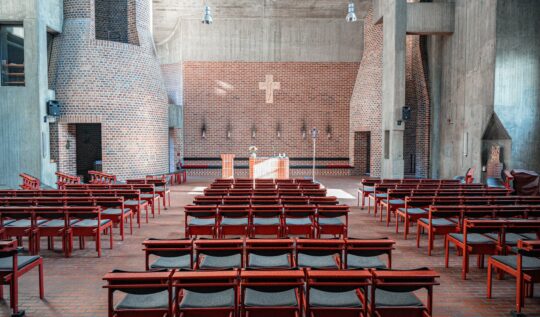
Programming is the phase of an architectural project that happens before design, and it is the part most people outside the profession have never heard of. During programming we are not drawing anything. We are investigating. The purpose is to understand and write down what the project genuinely requires before any line commits the owner to spending money. That means cataloguing every space the building needs, how large each one has to be, how the spaces relate to one another, and what each one has to do for the people inside it. A worship auditorium that seats six hundred is not simply a room with six hundred chairs. It carries with it a lobby that can hold the crowd before and after a service, restrooms sized to code for that occupancy, a platform and back of house that match the way the congregation actually runs a service, parking that the city will require, and circulation wide enough to move people safely. Programming is the disciplined process of surfacing all of that before it becomes an expensive surprise.
Part of why programming goes unnoticed is that it produces no glamorous artifact. There is no rendering to admire and no model to set in the lobby, only a clear, written understanding of what the building must accomplish. Yet that understanding is the foundation every later phase stands on. We sometimes describe it to clients as the difference between deciding what to build and deciding how it looks. The first question is programming, and getting it right is what makes the second question worth asking.
Why the Early Number Is Almost Always Wrong
The early square footage figure is rarely wrong because anyone was careless. It is wrong because it was produced without the information that only programming generates. Industry research on cost overruns consistently traces them back to the same root, which is that the project was defined too vaguely at the start and the gaps were filled in later, when filling them in is most expensive. A budget built on a guess inherits all the uncertainty of that guess. When the real needs surface during design, or worse during construction, the owner faces a hard choice between spending more than planned, cutting something they assumed was included, or delaying the project to redesign it. None of those outcomes is the architect’s fault or the contractor’s fault. They are the predictable consequence of beginning to design before the requirements were actually known, and we would rather spend the time at the front of the project, when changing the plan costs nothing but a conversation.
The Questions That Shape a Building
Good programming is mostly listening, and the questions matter more than the answers we might walk in assuming. We ask how the organization operates today, not in the abstract but on an ordinary Tuesday and on its busiest day of the year. We ask who uses each space, at what times, and what has to happen near what. A children’s ministry wing needs secure, controlled access and a check in point a family can find in seconds, and it should sit close enough to the worship space that parents feel comfortable but buffered enough that noise does not carry. A commercial kitchen has to be near loading and separated from the spaces guests occupy. These adjacencies sound obvious once they are stated, yet they are precisely the details that vanish from a project defined only by a total square footage.
We also ask about the future, because a building sized only for today is partly obsolete the day it opens. Honest programming means accounting for the growth an organization actually anticipates, not the growth that sounds impressive in a meeting. A church adding a second service has different needs than one planning to double in five years, and the building should reflect whichever is true. This is where programming and long range thinking meet, and it is why we treat planning for growth you can actually foresee as part of defining the program rather than a separate exercise. Designing to a number that simply feels safe is how organizations end up paying for space they do not need or running out of room far sooner than they expected.
Where the Program Meets the Budget
The reason programming deserves this much attention is that it is the moment a project’s cost is genuinely set, even though no one has drawn anything yet. The construction technology company Procore, in a clear primer on pre-design programming, makes the point that the earlier a change is made the cheaper it is, and that the cost of altering a building climbs steeply once a contractor is on site. A program that is honest about the building’s needs lets us put a realistic cost per square foot against real requirements rather than against a hopeful estimate. If that number comes back higher than the budget, and it sometimes does, the owner still holds every good option. They can expand the budget with their eyes open, phase the project so the most important spaces are built first, or decide together with us which requirements to trim. Each of those is a sound decision made in daylight. The bad version of this conversation is the one that happens eighteen months later, after the foundation is poured, when the only remaining options are the expensive ones.
From the research
“The earlier a change is made, the cheaper it is — and the cost of altering a building climbs steeply once a contractor is on site.”
For churches and nonprofits the stakes are higher still, because the budget is usually built from gifts rather than from a developer’s projections. A capital campaign asks people to give toward a specific vision, and if the program shifts dramatically after the money is raised, the gap is not only financial but a matter of trust. Defining the program well before the campaign means the number the congregation hears is a number the building can actually be built for. That alignment between what is promised and what gets built is one of the quietest ways an architect protects an organization’s credibility with its own people.
How We Approach the Program
This is also where programming connects to the feasibility work that comes earlier, because the land and the program have to agree with each other long before design begins. We have written about the work that should happen before a site is purchased, and the program is the natural next step once a site is sound. A program is only as good as the questions behind it, and good questions come from having seen how buildings of a given type actually get used. Across more than a thousand church projects and decades of commercial and civic work, we have learned which spaces clients consistently underestimate, which adjacencies cause regret when they are ignored, and where a stated need is really a different need in disguise. We bring that pattern recognition into the room, and we never leave an owner holding a problem with no path forward. When the program reveals a conflict between ambition and budget, we arrive with options rather than bad news.
The strongest building projects we have been part of are almost never the ones with the most dramatic design. They are the ones where the program was defined carefully, honestly, and early, so that every decision afterward rested on something solid. That is the value we try to bring before a single drawing exists, the discipline of asking the right questions, the experience to know which answers matter most, and the commitment to shepherd a project from that first conversation all the way to the final walkthrough. If you are early in thinking about a building, or even just sensing that you might need one, we would welcome a conversation before the number on the page hardens into a budget. There is rarely a better time to talk than now, while everything is still possible.
Let’s Talk About Your Project
Every project starts with a conversation. If you have something in mind — or just a question — reach out and we will get back to you within one business day.